Showing posts with label French fashion. Show all posts

Tuesday, August 23, 2016

Home again, home again...

Add to Google Reader or HomepageWe have been back in Lansing almost a month. We have settled in and our house feels like it is ours again. Clothes and objects that we stored so that our house-sitters would have empty closets and dressers are now back in their proper places.

I have claimed this so often to be boring but we live in the best neighborhood in the city/state/nation. Just one example: our neighbors wanted to surprise us when we came back to Lansing and since we had changed our calendar to be in France until the end of July, they prepared the soil and planted a vegetable garden for us. What a wonderful surprise! We have been enjoying the fruits of their labors since the day that we arrived. (I need more zucchini recipes!)

For the last eight years, we have been following our schedule of half-year here, half-year there. One would think that I had reported on all of the differences between our two life-styles but there are always things that surprise me when we arrive here (and there). 

One big difference this year, we stayed through two of the summer months: June and July. Vaison la Romaine changes a lot in the summer. First of all, the population doubles - from 7,000 to 14,000. A lot of people arrive with their bicycles. They fill the streets and the roads and, after a nice ride, the cafés. Vaison has one of the best street markets in Provence but in the middle of the summer it is packed with people. It is almost impossible to navigate through the throngs. (The locals have advised us to shop early - before 9:00 AM.) The shops that cater to tourists expand their hours. The cafés offer more live music at night thus the cafés are filled from morning until late in the evening. There is a proliferation of ice cream vendors. There are several ice cream specialty shops but the cafés also add ice cream coolers. If one could rank order the popularity of a type of store by the number of stores of that type, in Vaison in the summer the ranking would be beauty salons/coiffeurs, restaurants and cafés, bakeries, ice cream vendors, real estate sales offices... 

Vaison has become known for the dance performances held in July and August at the Roman Amphitheater. We went to one of the performances and I can only describe it as magical. The show started at 10:00 PM - just after sunset - and we and about 5,000 other people were finding our seats in a 2000 year old amphitheater that was built by the Romans. The performance that we saw was by an American company - the Los Angeles Dance Project - though the director is Benjamin Millepied is French and former director of the Paris Opera Ballet (and husband of actress Natalie Portman.)

Another observation: Even though we live in a village in France, people there dress better than people dress here. One expects people of Paris to dress well but the rules of fashion are somewhat relaxed outside of the large cities. One rarely sees people dressed as casually in Vaison as one sees people here. Even the tourists dress better in France. No sweats in public - ever! It reminds me of the quote about wearing sweat pants in public attributed to Jerry Seinfeld: “You’re telling the world ‘I give up.’” (Training outfits/warm-up suits are becoming more popular in France...) The contrast in fashion was underscored for me when I encountered a woman who was wearing pajamas as she shopped in one of the local superstores. Now that is casual! Welcome home!

Thursday, July 14, 2016

Nantes and Paris

Add to Google Reader or Homepage 
We went to Nantes to visit a dear friend. (We also got to see a friend who we have not seen since she was in East Lansing in 1980!) Nantes is at the mouth of the Loire River on the western coast of France. It was not our first trip there but was the most memorable. We toured the city with our friend who was born and raised there so he is very knowledgeable guide. He lives in the center of the city so we walked most places. 

We took the “Navibus” to the other side of the Loire river and walked around the village of Trentemoult. We visited the island of the city and got to see the huge (three stories high) mechanical elephant that walks around the island.

We went through the castle of the dukes of Brittany (le Château des ducs de Bretagne) and ate at a lovely restaurant facing the castle (Le Fou du Roi - the Court Jester). Every meal during our visit was excellent and, since our friend is a very knowledgeable connoisseur of wine, we drank well.

Note: Nantes was thirty degrees Fahrenheit cooler than Vaison. Everyday, we went out with a jacket!

We left Nantes and took the fast train to Paris. We visited our friends who were staying in Paris for several weeks. Paris is always awesome.

We had planned to go to an American restaurant for dinner on the 4th of July. (American Independence Day is not a holiday in France.) Two of the Americans with whom we were going to eat did not like the restaurant so we decided instead to find a restaurant in the neighborhood that made hamburgers. We found the perfect café and had great hamburgers and fries - with Heinz catsup!

We went to Versailles to see the new exhibition of paintings depicting the role of France in the American Revolutionary War. (The French call it the War of Independence.) It was a very engaging and enlightening exhibit. Somewhere in my past, I remembered that La Fayette had helped Washington and that the French had also sent naval support but I always thought of the French help as a small footnote on the war. The French were very much involved in supporting our independence and fighting England.

There was an exhibit of three hundred years of women’s fashion at the Museum of Decorative Arts. I am probably showing my age but I much prefer the hoop skirts of the seventeenth century to some of the extravagant (outrageous?) fashions of the current time. (There was also a Barbie exhibit at the same building but we decided not to pay to see that exhibit.)

On our last day in Paris, we went to Montmartre - the highest part of Paris. We found a little café and had a wonderful lunch and then spent the afternoon climbing and descending the hills of Montmartre. Ellen wanted to see the little vineyard in Montmartre because she wanted to compare it to the little vineyard our friend had shown her in the center of Nantes. 

As we walked around Paris, I was asking myself if anyone there spoke French. I heard many languages most of which were not French. Maybe it was the multitude of tourists, maybe it was because July is one of the two vacation months for the French and the French-speaking Parisians had left the city. For whatever reason, it was amazing to hear so many languages. 

Bonne fête nationale de France! Happy Bastille Day!

Wednesday, January 29, 2014

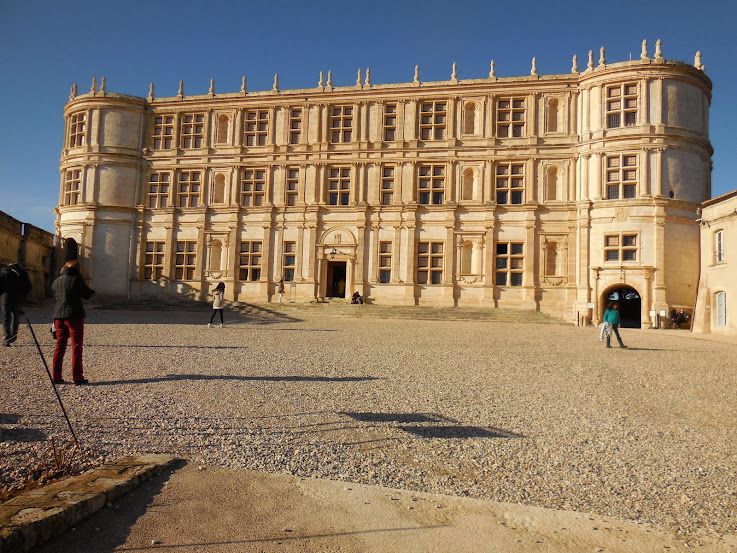
Chateau de Grignan

Add to Google Reader or HomepageAbout a half hour north of Vaison la Romaine is the village of Grignan. The most prominent aspect of the village is the restored castle that sits at the top of a rocky promontory.

Chateau de Grignan
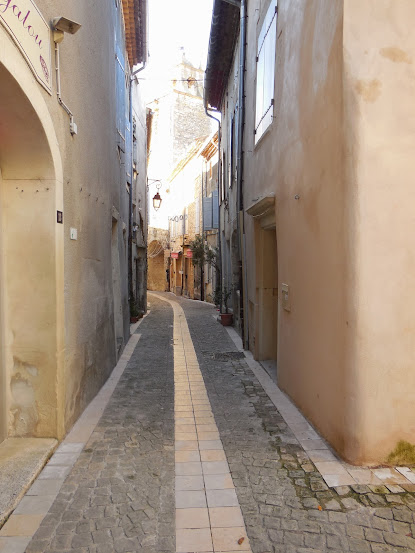
Street in the village of Grignan
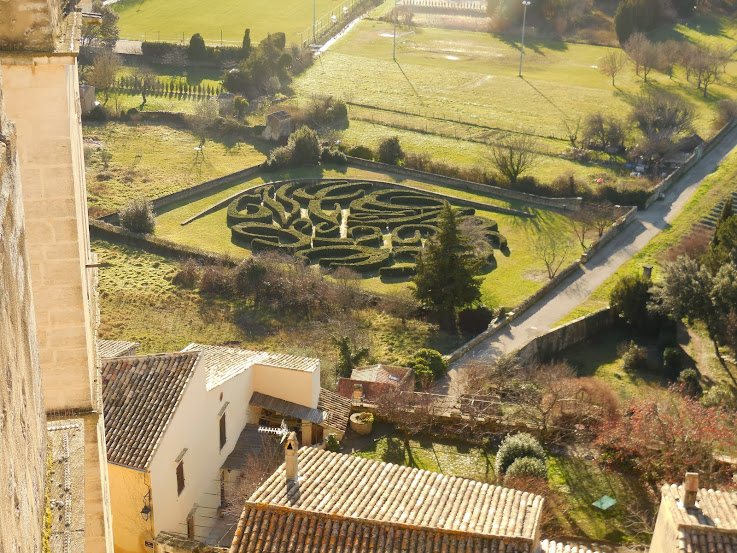
The gardens of the castle, below.
The history of the castle indicates that the first home was built in the 11th century then expanded in the 13th century and was the fortress around which the medieval village developed. The castle was rebuilt in 1479-1495 during the Renaissance and then destroyed during the French Revolution because it was one of the « monuments qui insultent l'égalité en rappelant ces temps de servitude, de féodalité et de superstition, dont le fardeau a trop longtemps pesé sur un peuple rendu à la liberté » “one of the monuments that insults equality by making one remember the times of servitude, feudalism and superstition for which the burden has rested too long on the people who have now acquired liberty.” In the early 20th century, the castle was purchased by a woman who worked with an architect and restored the chateau to its original beauty. The work continued from 1913 until 1931. Ultimately, the chateau was sold to the Department of Drome in 1979 and became an historic monument in 1987.

While the history of the building is noteworthy, there is an equally interesting about one of its inhabitants and her mother. It is the story of the letters from Madame de Sévigné to her daughter Françoise-Marguerite. Madame de Sévigné lived in Paris and her daughter married and moved to the castle to become the Countess of Grignan. Madame de Sévigné wrote over 1,000 letters most of which were to her daughter whom she missed very much. As a wealthy woman in Paris, she visited the court of Louis XIV and met the king as well as the high-society women of Paris. Her letters offered insights into the lives of Parisian aristocracy: what people were talking about, what people were seeing at the theatre, what books were popular, etc. Her descriptions were lively and heart-felt. She became widely known as a letter writer (une épistoliere) who offered wonderful descriptions of daily life among the aristocracy. Many of her letters were copied and distributed even before they were sent. She wrote not only to her daughter but to the wider audience of readers that she knew were waiting for her next letter. 

Madame de Sévigné is considered one of the icons of French literature. L'absence de la comtesse a fait d'une femme sans ambition littéraire un auteur par la volonté de combler son manque affectif et de consoler sa douleur... Parce qu'elles sont une recomposition de la réalité à travers le prisme de l'amour maternel, elles deviennent littérature. The absence of the countess turned a woman without literary ambition into an author by the will to fill her emotional void and to comfort her pain… Because they (her letters) are a restructuring of reality through the prism of the maternal love, they become literature; (Hélène Bernard, editor, Madame de Sévigné: Letters. Flammarion, Paris, 2003.)

Monday, December 19, 2011

Back in France

Add to Google Reader or HomepageReturning to France makes me smile. I smile at the changes I know are going to be part of our lives for the next six months.

The topography always strikes me first. Flying to Marseilles over the Mediterranean and seeing the small uninhabitable islands jutting out of the water. Then there is Marseilles and the backdrop of steep limestone hills. Along this section of the Mediterranean, the hills start at the water and climb as cliffs up to plateaus. You leave the airport and get on the autoroute heading north. The autoroute mostly follows the Rhone valley and minutes after leaving the congestion of Marseilles, one is surrounded by vineyards and farms and more vineyards. Olive trees, with their silver-green leaves, break up the scenery.

Blue sky, green pastures, blue/gray clay under the vines (the leaves are gone), limestone cliffs and the meandering Rhone river make a stunning tableau. Gorgeous. Conversely, I was struck by the amount of smoke pollution I noticed this time. Maybe living with little heavy industry in Lansing masks the amount of smoke pollution we make or see, but here, one sees smoke rising from all sorts of buildings both near and far.

People are enchanting to watch anytime and anywhere, but on the European side of the Atlantic, I am struck by how differently people look. You know you are “not in Kansas anymore.” Clothing, shoes, sacks/purses, hair styles, jewelry, even glasses frames are very different from the way we are used to seeing people in the US. If you see someone wearing “sweats,” s/he is likely an American. I don’t wear sweats, but the French seem to know that I am American. Is it something tattooed to my forehead like a Harry Potter scar that says "this one is not one of us"? Europeans not only look different, they speak differently (and look different when speaking.) I noted in a previous blog that the French seem to start words by forming their lips as if they were going to kiss. Americans form words from a smile. Germans and northern Europeans start their words with a frown.

Then there are the cars. Smaller, diesel, much more efficient and the diesel doesn’t stink! On the autoroute, if you are passed by a car going 150 km/h, it is likely going to be German-made. I guess that if you buy a Mercedes or a BMW, you are obliged to drive as if every road was the Autobahn.  I also smiled as we passed a sign announcing that there is a speed trap ahead where a camera will get a picture of your license plate if you are exceeding the speed limit. (How is it that they still catch speeders and issue tickets? – What part of “speed camera ahead” don’t people understand?)

I even had to smile on my first return to the grocery store where the shopping carts have four wheels that rotate (rather than only the two front wheels on shopping carts in the US). When you are in the grocery store and want to turn left, you can’t push on the handle and expect the fulcrum of the frame to assist, you must conscientiously turn ALL FOUR WHEELS so that you make the turn without running into the end-of-counter displays. On the other hand, you can easily move the cart left or right to get closer to the products or to get out of the way of another cart.

And the food! How I love the food! Two years ago, my sister-in-law and her husband were here and he wanted to have “fat-free half & half.” I told him that the French didn’t understand that concept. You can get skim milk, but when it comes to cream, the French LOVE their fat-filled creams and “crème fraiche” and cheeses… and, as we learned just last evening about cheese, it is not only where the cheese is produced, it is from which breed of cow…! (DeGaulle was right when he asked how anyone could govern a country that had more than 200 kinds of cheese.)

After the first level of slaps-upside-the-head reminding me that I am no longer in the US,  I begin to settle into the life of the village where people say “hello” as you walk by or as you enter their shops. And they stop their cars when you stand at the crosswalk… all the while thinking to themselves: “Who is this American and why is he smiling so much?”

Friday, March 27, 2009

Fashion Police


Add to Google Reader or HomepageEveryone knows that I have no right to make observations about fashion. I consider myself “à la mode” when my socks match. Nonetheless, I have admired French fashions that we encounter everyday. Evidemment, Vaison la Romaine is not Paris and fashion is more casual here than there but it is not “à la mode mid-ouest” either.

One of the most enduring, albeit surprising, fashion statements is Converse Allstar basketball shoes. I am referring to “high tops” though young adults – men and women – wear low ones as well. These were the basketball shoes of choice when I was in high school (back in the days when a peach basket with the bottom missing served as the basket.) You can get “Chuck Taylor” Allstars in canvas or leather; in almost any color you want; with designs printed on the shoes or not… There aren’t a lot of people my age wearing Converse Allstars but I suspect that it is because the shoes don’t accommodate orthotics well. (Our French teacher was wearing a pair – red leather - today!)

The second most common footwear among women is high boots with high heels and pointed toes. (Toes with such acute points that one could kill the spider in the corner…) One rarely sees plain leather boots. The boots need straps or buckles or laces or zippers or combinations of all of those…

Falling from the fashion charts are Puma athletic shoes though I still see them fairly often. These are Puma track shoes – very light with what appears to be very little structure but with the Puma trademark stripe/swoosh on the sides.

A definite “This is an American” marker is a pair of Nikes or Adidas or Reebooks or any of the footwear that Americans wear less as a fashion statement and more as a “fitness” statement (though there is a limited – if any – correlation between fitness and what one wears on one’s feet.)

Ten years ago, Ellen objected to my plan to bring jeans to France as part of my wardrobe. TIMES HAVE CHANGED. Jeans are ubiquitous (I think that means expensive). The more expensive, the better… One way to earn money here in France would be to bring American jeans and sell them in the market. Levi Strauss, Lee and Wrangler are all very popular here – and cost about three times as much as in the states. French boys wear their jeans just like American teens – baggy and defying gravity. Women wear TIGHT jeans. The majority of women wearing jeans are so thin that their inner thighs don’t touch. Both young men and young women seem to like jeans with extra details like zippers as closures for pockets, laces, rhinestones, embroidery…

If women are wearing skirts or dresses, the skirts will most likely be black and often will have irregular hems – points rather than straight hems. It seems that the mode this year is to take different fabrics, piece them together and then sew them as a dress or skirt – and then adorn the creation with buttons or laces or rhinestones… The exceptions to straight hems are sweater dresses – or just sweaters – that fall centimeters below the butt line… Whether it is jeans or slacks or skirts or dresses, women use belts (huge, wide, ornate belts) to complete the statement.

I am surprised how often people have shirts or sweatshirts or blouses or sweaters that have an American logo or an American expression on them. Women’s tops have to be designed to show off the lingerie for which women seem to spend a fortune. Given the number of lingerie shops in Vaison la Romaine, I would venture a guess that a good foundation is second only to good eyesight (there are more optical shops than any other type of boutique.) French people/Europeans seem to buy dramatic glass frames that shout “Hey! Look at me!”

The scarf is the final touch to a complete look. Scarves are more prevalent than jeans though equally expensive. In one sense, it seems counter-productive that, after putting together lingerie and a top, a woman will cover both with a scarf – but scarves do keep you warmer. Speaking of warmer, since we have spent the winter here, we have seen a lot of hats. Berets are extremely popular (duh!) for both women and men. For men, hats with brims seem to be the most popular, but baseball caps are gaining popularity.

So, if you are wearing black and/or Chuck Taylors, smile! You ARE à la mode!