Tuesday, March 11, 2014

A Walk in the Park

Le Sentier le Mérindol les Oliviers
Add to Google Reader or Homepage
I have mentioned in previous blogs the hiking system in France and the number of well-marked and well-maintained trails that are available to us.

Sunday, we went with Jane to hike the “Sentier le Mérindol les Oliviers”. The terrain was not very challenging – a short climb up a hill and then vistas that were breath-taking, then around a summit on top of which is an old medieval castle that has been restored and made into a family dwelling, back down the hill (on tarmac) to the starting point. The route was well-marked and it was clear which paths we were supposed to/allowed to take.

Castle from the south
Castle from the north


Cherry Blossoms

Saturday, March 8, 2014

Potty Talk

Add to Google Reader or HomepageWe went to one of the five cafés on Place Monfort – the square in the center of town  - for lunch and, before we left, I went to the bathroom. The trip is a common occurrence given my age and the elasticity of my bladder. Anyway, it made me think of the differences between restrooms in the States and in France.

The first big difference is that in France, the bathroom is NOT the toilet room. Most of the time, the toilet room is separate and, if you are lucky, has a sink for hand-washing (we don’t). The French explain that the bathroom is for bathing. The toilet room is for toileting but NOT for toiletry which occurs in the bathroom.

So, when you are in a restaurant, you ask: “Où sont les toilettes.” Always asking where the toilets (plural) are, but when you get directions and arrive at the toilettes, there may be only one. But you can never ask : « Où se trouve la toilette? » Because « la toilette » refers to doing your morning time in the bathroom in front of a mirror (faire la toilette).

There is a big difference between toilet rooms in the states and here. In France, most toilets offer a two-button flush: one for light, one for full flush. The second difference is that French restaurants don’t seem to have to comply with ‘handicapper accessible’ to the extent that American restaurants must. I believe that most toilets in French restaurants are NOT handicapper accessible. But then, most restaurants are not handicapper accessible - unless the handicapper/chair user wants to sit outside – assuming that the handicapper/chair user was able to negotiate the lack of curb cuts, narrow sidewalks, etc. Note to self: write something about handicapper accessibility…

Another difference is that the French are much less puritanical than we, so, there might be a toilet room for men but the stand-up options are visible to the women who might be walking by… (It is not very different from the denizens of men who ‘water plants’ along the roadways.)

Whether it is a small café or a big restaurant, the “Dyson” hand drier is the “le top” (new French word). It is so much more efficient than the slow, old air dryers. I don’t know how it compares ecologically with the restaurants that continue to offer hand towels…

Oh, BTW (aka ‘by the way’) I almost forgot that there are many toilets in the restaurants that do not have a toilet seat. I don’t know whether it is because they have decided that one more thing to clean is ‘over the top’ or because they have decided that a toilet seat makes it so comfortable that one might choose to remain there longer than necessary. Whatever the reason, few “toilettes” have seats…

Sunday, February 23, 2014

"Only Lyon"

Add to Google Reader or HomepageAbout a month ago, we went to Lyon to pick up friends at the airport. Since Lyon is the “gastronomic” capitol of France, we decided to go early and enjoy a meal at one of Lyon’s restaurants. We got miserably lost and almost forfeited our reservation. Despite a WONDERFUL meal at 126, we decided that the city was too large and too easy to get lost and thus took Lyon off of our “must visit” list.

When we told Jane of our experiences and resulting decision, she countered with: “Lyon is beautiful. Let’s give it another try.”

We found a nice apartment in the Croix Rousse section of the city via VRBO and made our plans to visit. Between Jane’s good driving and Ellen’s Google maps, we made our way directly to the apartment without problem. It was a two bedroom apartment furnished in IKEA modern. It also had a garage – a big plus!

The owner explained that the apartment was originally a silk shop – many of the old buildings in the Croix Rousse section were. The area of the kitchen/living room was where they had their loom thus explaining the extremely high ceiling. The bedrooms were used for storage and a small door – where there is now a wall adorned with a huge mirror led to the sleeping space.

Lyon is located at the confluence of the Rhône and the Saône rivers. It has been an important city since Roman times. The old town is located between the rivers on the ‘Presque Isle’. The Croix Rousse neighborhood sits above the old town offering wonderful views of the city. Lyon became the silk-weaving capitol of Europe during the Renaissance. The silk workers – les Canuts – made silk and wove it into fabric. They built covered passages – called Les Traboules – to move the silk protected from the rain from Croix Rousse to the merchants in the lower parts of the city. Many of these passageways still exist.
Ellen and Jane check out one of the Traboules
Despite the decline of the silk industry in Lyon, the city remains vital. It is now called the gastronomic capitol of France. Paul Bocuse, who is one of the proponents of Nouvelle Cuisine, is from Lyon. It is therefore easy to find excellent restaurants. Three days, three wonderful restaurants. Some Lyonais restaurants are called Bouchon which normally means cork or blockage but in Lyon it stands for restaurants that serve local favorites – from local sources. We chose – Le Bouchon des Filles – and selected from the menu du jour from which we chose: rognons de veau (veal kidney), quenelles (shredded fish incorporated into a dumpling and saucisse (sausage). The meal was excellent. Even their pichet de vin was better than most table wines. (Lyon is situated between Burgundy to the north and the Northern Rhône Valley so finding excellent wines is easy.)

Another facet of Lyon is the “trompe l’oeil” murals found around the city. We found two while we were walking but saw another four as we were leaving and driving along the Saône.

Look closely. I am standing in front of the mural!
A major ad from the Tourist Bureau is “Only Lyon”. We appreciated the anagram. It is a wonderful city.


Saturday, February 15, 2014

Happy Valentine's Day

Add to Google Reader or HomepageThe evening started with a note from Dan reminding me of a wonderful lunch on St. Valentine’s Day at Les Abeilles in Sablet eight years ago with a group of friends. It ended with an espresso after another wonderful meal at La Lyriste in Vaison. 

Benoit, chef at La Lyriste, mentioned that he was planning the menu for St. Valentine’s Day when we were having dinner with them last week. I asked Marie to make reservations for us. (Good idea!)

The meal started with a glass of champagne and Amuse bouche.


The entrée was: Queues de Gambas Laquées au Sirop de Liège, Huile Basilic.
 Shrimp tails painted with fruit syrup and served with Basil oil 
  (on a bed of fennel, leeks and potatoes).


We chose a wine from one of the local (Vaison) vintners whom Dan and I met last spring. It was a nice CdR that paired well with the veal and the cheese. The young vintner and his wife have only three hectar of vines but they make nice, old-world style wines.

Terre de Gaulhem, 2010
The main course was:  Pavé de Veau Blanc Roti au Thym, Sauce Champignon, Pomme de Terre éecrasée au curry; a perfectly prepared piece of veal served on a bed of smashed potatoes gently flavored with curry. The mushroom sauce added a nice touch. (I let my appetite get ahead of my camera and ate too much of the main course before I remembered to get a picture.)

The cheese course – Camembert Pané was a lightly breaded piece of Camembert served on lettuce.


The dessert, oh the dessert: Ananas/Crème Tendre au Chocolat. I thought it was chocolate mousse served on thin slices of pineapple. Ellen thought it was ganache served on thin slices of pineapple. Either way, it was great.


Happy Valentine’s Day!

Wednesday, January 29, 2014

Chateau de Grignan

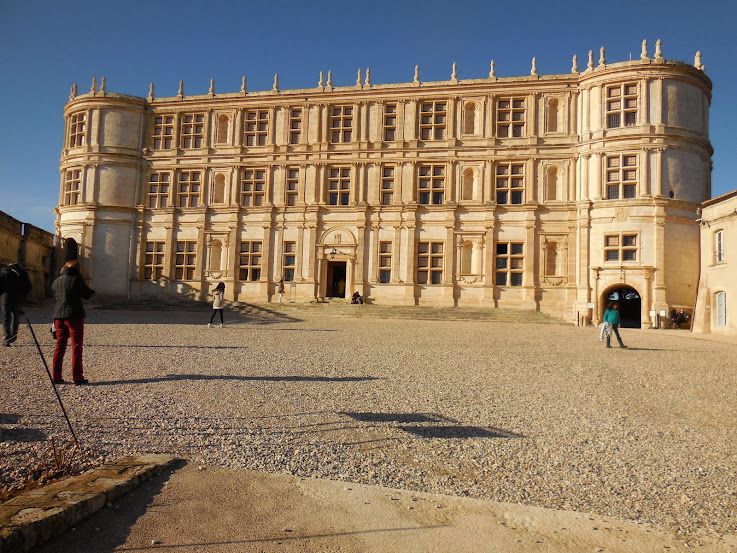
Add to Google Reader or HomepageAbout a half hour north of Vaison la Romaine is the village of Grignan. The most prominent aspect of the village is the restored castle that sits at the top of a rocky promontory.

Chateau de Grignan
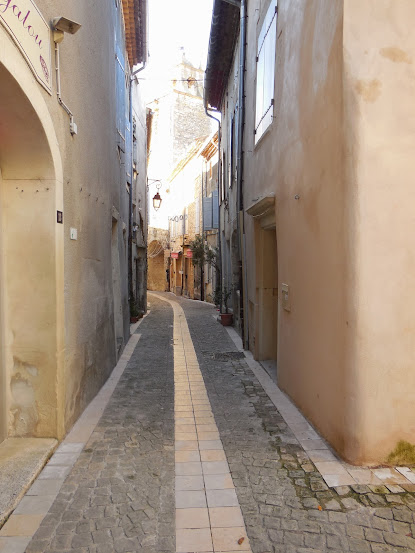
Street in the village of Grignan
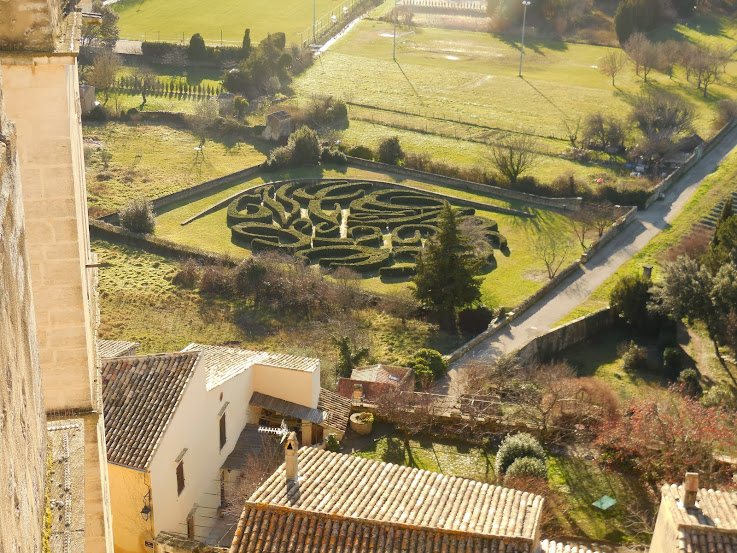
The gardens of the castle, below.
The history of the castle indicates that the first home was built in the 11th century then expanded in the 13th century and was the fortress around which the medieval village developed. The castle was rebuilt in 1479-1495 during the Renaissance and then destroyed during the French Revolution because it was one of the « monuments qui insultent l'égalité en rappelant ces temps de servitude, de féodalité et de superstition, dont le fardeau a trop longtemps pesé sur un peuple rendu à la liberté » “one of the monuments that insults equality by making one remember the times of servitude, feudalism and superstition for which the burden has rested too long on the people who have now acquired liberty.” In the early 20th century, the castle was purchased by a woman who worked with an architect and restored the chateau to its original beauty. The work continued from 1913 until 1931. Ultimately, the chateau was sold to the Department of Drome in 1979 and became an historic monument in 1987.

While the history of the building is noteworthy, there is an equally interesting about one of its inhabitants and her mother. It is the story of the letters from Madame de Sévigné to her daughter Françoise-Marguerite. Madame de Sévigné lived in Paris and her daughter married and moved to the castle to become the Countess of Grignan. Madame de Sévigné wrote over 1,000 letters most of which were to her daughter whom she missed very much. As a wealthy woman in Paris, she visited the court of Louis XIV and met the king as well as the high-society women of Paris. Her letters offered insights into the lives of Parisian aristocracy: what people were talking about, what people were seeing at the theatre, what books were popular, etc. Her descriptions were lively and heart-felt. She became widely known as a letter writer (une épistoliere) who offered wonderful descriptions of daily life among the aristocracy. Many of her letters were copied and distributed even before they were sent. She wrote not only to her daughter but to the wider audience of readers that she knew were waiting for her next letter. 

Madame de Sévigné is considered one of the icons of French literature. L'absence de la comtesse a fait d'une femme sans ambition littéraire un auteur par la volonté de combler son manque affectif et de consoler sa douleur... Parce qu'elles sont une recomposition de la réalité à travers le prisme de l'amour maternel, elles deviennent littérature. The absence of the countess turned a woman without literary ambition into an author by the will to fill her emotional void and to comfort her pain… Because they (her letters) are a restructuring of reality through the prism of the maternal love, they become literature; (Hélène Bernard, editor, Madame de Sévigné: Letters. Flammarion, Paris, 2003.)

Tuesday, January 14, 2014

Locavores – Part deux,

Add to Google Reader or Homepage
After only 10 days of our journey into the land of “Locavores” – where one buys only locally grown/raised products – I can offer four observations: the land of “Locavores” is more expensive, more time-consuming, requires more planning and is more interactive.

1.      Shopping locally (instead of in the box-stores) is more expensive. The prices are marginally higher. The local shops may have their devoted clientele but in order to maintain that loyalty (and to entice more customers), the local stores have to remain somewhat competitive – and they do!

2.      Shopping locally takes more time. As my friend Susan commented:  “I think one has to be retired to embark on such a venture, but i do love shopping at our market in Ann Arbor even though it takes a hit on the pocketbook - always the bummer that eating healthy and ecologically is not for those with few resources.” I have found every word of Susan’s observations to be true. I am thankful that I am retired and love that I have the time and opportunity to pursue the locavore life style. There is a time-saving aspect to shopping in big supermarkets. At the box stores, I need only go to the appropriate aisle; I don’t need to stop at the butcher shop, the green grocer or the cheese shop to get what I want to cook that evening. At the box-stores, I can get all of the items on my shopping list at one store – never mind that they may come from Holland or Morocco or Israel… (or, in the case of almonds – generally considered to be a local/Provençal cash crop – California!)

3.      I can confirm that shopping locally requires more planning. The local shops follow the French schedule of being open until noon, closed for 2 ½ hours for lunch and then open until 6:00 or 7:00 in the evening. Most of the local shops are also closed on Sunday and Monday, so when planning meals for those days, it is important to do my shopping by Saturday evening. On the other hand, the local shops are only a five-minute walk from our apartment, so they are easy to access – when they are open.

4.      Shopping locally means more interaction with the shop owner/counter person. At the big box-stores, you can find what you want without interacting with anyone. (For those of us with questionable language skills, that is a BIG plus. You don’t have to ask for an item if you can find what you are looking for.) On the other hand, interaction is a good thing. The shop owners begin to recognize you and that often leads to a conversation. Speaking with the shop owners improves one’s vocabulary and speaking skills (and you will have learned new words as you look up the words for the items that you want to buy before you go to the store).

We like the vegetables and meats that the local stores offer, like knowing that we are contributing to the local economy and are probably benefiting from eating foods that are grown/raised with fewer pesticides or insecticides (?).

Isn’t that a “win-win”?

Friday, January 3, 2014

"Locavores"

Add to Google Reader or HomepageHe probably smiled to himself as he made the decision to send the book to me. He knows me very well and knows how the hypothesis would work on me. He has seen how we live in France and probably made a connection.

Now we are back in France and I am trying to address that for which I have been ruminating as a result of John's gift of Animal, Vegetable, Miracle by Barbara Kingsolver and family.

The book is about how they became “locavores” for a year at their family farm in southern Virginia. The family agreed to eat only what they could obtain from their own garden/farm or the gardens/farms of neighbors. That meant no broccoli or oranges from California, no lamb from New Zealand, no red bell peppers from Holland or anything outside their region. The author claims that “Every food calorie we presently eat has used dozens or even hundreds of fossil-fuel calories in its making…” and once the food is processed, “Each food item in a typical U.S. meal has travelled an average of 1,500 miles” (co-author Stephen Hopp). The family wanted to know where things were raised and how things were raised: (pesticides? herbicides? growth hormones? antibiotics?)

So, as John knew it would, reading Animal, Vegetable, Miracle has caused me to assess my shopping habits from a “locavore” perspective. When we are in Michigan, I go to the Allen Street Farmers Market on Wednesdays or make meals from the vegetables of my own garden (no pesticides, no herbicides there!). The majority of my food shopping is nonetheless done at big box stores. I do pay attention to finding fruits and vegetables that are in season – as in Michigan’s seasons. (I love it when asparagus from western Michigan is available and cheap In the spring).

In France, I think it will be easier to get closer to a “locavore” profile. For one thing, the French display prominently the country of origin of all fruits and vegetables.  Restaurants usually have a display showing the sources of beef and pork.  Cheeses, some meats and wines are origin-protected. Origin-protected means, for example, that only the sparkling wine that comes from the Champagne region of France can be called ‘champagne’. (You may remember my post a few years ago when I bought a 10 pound origin-protected turkey for Christmas and paid more than 100 € for the privilege – to my great shock.)

If Ellen and I are to be “locavores” in France, it would mean shopping at the local independent stores and not at the big box stores. The one ‘caveat emptor’ is that in the center of town there is a small grocery – part of a franchise large enough to offer their own brands…

We are going to try it. (John probably predicted this decision.) That means that we will buy our vegetables at the local épicerie (grocery store), our meats at the butcher shop and our fish from the fish monger and continue to buy our bread at a local, made-here bakery. I will include the market on Tuesdays as it is the day on which we can buy all that we might need even though the Tuesday market includes fruits and vegetables from Africa and Spain. (The “little” market on Saturdays is populated with farmers who bring produce from their farms.)
Since we are starting “cold”, I don’t have a cellar filled with canned vegetables or fruits that I could use to bring some summer back to the menu. I will have to get really creative to make inviting dishes to reduce the boredom of winter vegetables. “On verra.” (We’ll see) how this works out. Stay posted.